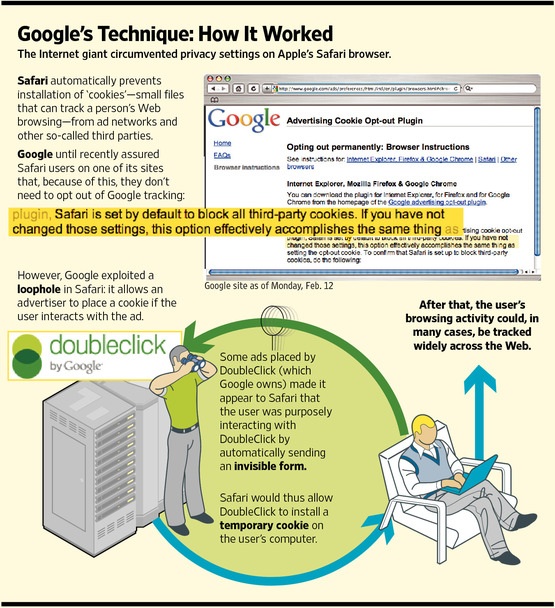
The Wall boulevard Journal stories that Google and a couple of different merchandising agencies were found out to be circumventing privateness protections in Apple’s Safari browser for iOS units with the intention to track users via commercials on a large number of popular internet sites. Google applied the technique so as to embed +1 buttons on its commercials, tricking users’ programs into permitting cookies via the use of an invisible form submission to make Google’s third-birthday celebration cookies, which can be blocked through Safari, seem as first-party cookies which can be allowed.
To get round Safari’s default blocking, Google exploited a loophole in the browser’s privateness settings. while Safari does block most monitoring, it makes an exception for internet sites with which a person interacts someway—for example, via filling out a form. So Google added coding to a few of its commercials that made Safari think that a person was submitting an invisible type to Google. Safari would then let Google install a cookie on the telephone or pc.
The cookie that Google installed on the pc was once transient; it expired in 12 to 24 hours. but it might probably sometimes lead to intensive tracking of Safari users. that is because of a technical quirk in Safari that permits companies to easily add extra cookies to a user’s laptop as soon as the company has put in as a minimum one cookie.
Google halted the observe as soon as it was contacted by means of The Wall side road Journal about it, however has tried to downplay the impact of the problem.
In a observation, Google stated: “The Journal mischaracterizes what happened and why. We used known Safari performance to offer options that signed-in Google customers had enabled. it’s important to stress that these promoting cookies do not acquire personal data.”
In a accomplice blog put up, The Wall boulevard Journal notes that the loophole that had accredited Google to circumvent Safari’s privacy protections has been closed in WebKit, the open source engine at the back of Safari, with the exchange having been made by using two Google engineers. consequently, Apple could and seems to be getting ready to deliver that restoration to the public version of Safari.
An Apple spokesman mentioned: “we are conscious that some third events are circumventing Safari’s privacy options and we’re working to put a stop to it.”
An update to the device that underlies Safari has closed the loophole that allows cookies to be set after the automated submission of invisible forms. Future public versions of Safari could contain that update. The individuals who handled the proposed trade, according to device documents: two engineers at Google.
the issue was once found out by using Stanford graduate student Jonathan Mayer, who has additionally printed an extensive weblog submit providing further technical important points on how Google and different advertising corporations circumvented Safari’s default cookie settings.
up to date Mac and iOS weblog stories
• March insanity involves iPad and iPhone March 7 for $3.ninety nine
• Apple bought more iOS units in 2011 Than It offered Macs in nearly 30 Years
• OS X Mountain Lion Drops fortify for many 2006-2008 Macs with integrated graphics
• Apple Wins German Injunction against Motorola Over "Swipe to unlock" Patents
• Apple Seeds Safari 5.2 for OS X Lion to builders

more: persisted right here