Following final week’s rumor that Apple is having a look to undertake thinner in-cell touch expertise for the display of the next-generation iPhone, analyst Ming-Chi Kuo, who lately took on a brand new place with KGI Securities, has issued a file looking at how that adjust may lend a hand Apple scale back the thickness of the iPhone from the present 9.three mm of the iPhone 4S to underneath 8 mm. The move would lend a hand Apple to compete towards its Android-based challengers, which have endured to see rate reductions of their thickness over time.
when you consider that Apple’s smartphone rivals have most often slimmed down their excessive-end offerings to 7-8mm, Apple must make a leap forward from 4S’ 9.3mm thickness. We imagine Apple will goal at 8mm or below (at the least 1.4mm slimmer) for iPhone 5, in a bid to ensure brisk gross sales thru 2014, while friends may even proceed to introduce increasingly more slim models next yr.
As such, all iPhone 4S elements that account for thickness should be slimmer, namely, contact panel, battery and casing. moreover, a marginal quantity of house is required between the three parts for the sakes of assembly tolerance and thermal growth of parts.
Kuo calculates that shifting to in-cell contact know-how within the next iPhone will yield Apple just shy of zero.5 mm with regards to a discount in thickness. Kuo envisions a identical reduction coming from the battery, which he predicts Apple will be able to increase reasonably inside the casing, bearing in mind a roughly 10% reduction in battery thickness.
A remaining zero.5 mm reduction in thickness could come from using a metal back case, which might come in at 1/2 the thickness of the glass again used within the present iPhone. Altogether, Apple might shave 1.4 mm from the iPhone’s thickness to deliver the following-generation version in at just 7.9 mm thick.
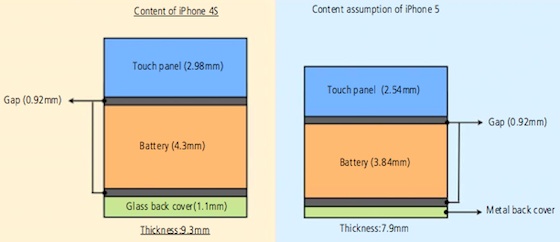
In but some other argument for the adoption of in-cell contact expertise for the show in the next-technology iPhone, Kuo notes that show manufacturing would be greatly simplified, with fewer steps in the manufacturing process and fewer companies being concerned resulting in an estimated discount in production time from 12-sixteen days to simply three-5 days.
while the preliminary yield on in-cell touch shows is presently lower than for glass-on-glass manufacturing techniques such as those used for the iPhone 4S, that deficiency can also be compensated for through re-bonding in-cell panels and cover glass devices with the optically clear resin (OCR) used within the bonding process. The optically clear adhesive (OCA) used in the present manufacturing course of can’t be re-bonded if the preliminary bonding fails.
recent Mac and iOS weblog tales
• Blizzard Launches Free Open Beta Weekend for Diablo III
• Quake four, complete with move-Platform Multiplayer, Arrives on the Mac App retailer
• halfway Arcade adds iCade reinforce
• crops vs. Zombies gets New Modes and Mini-games
• Apple desires Trial in iBooks Antitrust Case
extra: endured here